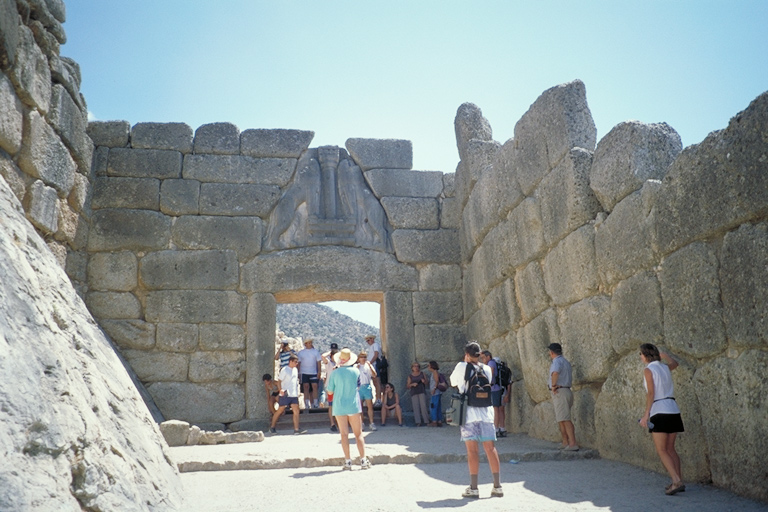
photo copyright Janice Siegel
| Mycenae: Schliemann
knew the place existed because he read about it in Homer (it is known as the
home of Agamemnon, one of the leaders of the Greek expedition against Troy
celebrated by Homer and later authors). Schliemann was sure that Homer had
left enough clues for him to find it. And find it he did. Note the “Cyclopean
Walls” – rocks cut to size and placed one on top of the other with no mortar
to hold them together. Legend had it that only the Cyclopses could have done
it. Citadel and fortification walls predate the Archaic Age (when Homer
wrote, c.750 BC) and the Classical Age Greece (when the Athenian dramatists
did, ca. 480-406 BC). Parts of the complex, including the royal grave
circles, date as far back as 1600 BC, but much of the citadel construction
appears to coincide with the historical date given to the Trojan War, 1183
BC. The Lions decorating the relieving triangle space in the Gate (each
resting a paw on the propylon, the support of the House of Atreus), is taken
to be the same lion associated with the House by Aeschylus in the only
surviving trilogy from antiquity, The Oresteia. |