Cycladic (civilization primarily on the Cyclades island group)
the MINOAN AGE (civilization primarily on the island of Crete from c.2000 BC - c.1450 BC)
the MYCENEAN AGE (civilization primarily in southern mainland Greece from c.1600-c.1100 BC)
 |
 |
 |
| Pylos | Mycenae | Tiryns |

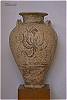 On
the left, note the "loose octopus" of the Minoan vase (top), as compared to the
ram-rod-stiff-at-attention octopuses on the Mycenean sarcophagus (bottom). Although the
Myceneans were unlike the Minoans in that they were war-like and lived in fortified
citadels and left behind weapons among their bronze tools (hence the name Bronze Age),
Mycenean culture had much in common with their predecessors, too, and there is little
doubt that they traded with the Minoans before their demise. Cultural similarities range
from a shared alphabet (Linear B tablets have been found on both Crete and the mainland)
to uncannily similar designs of frescoes used to line the walls of their homes. Two each
of the examples below were found in Cnossos (Crete), in Tiryns (mainland), and in Akrotiri
(Santorini).
On
the left, note the "loose octopus" of the Minoan vase (top), as compared to the
ram-rod-stiff-at-attention octopuses on the Mycenean sarcophagus (bottom). Although the
Myceneans were unlike the Minoans in that they were war-like and lived in fortified
citadels and left behind weapons among their bronze tools (hence the name Bronze Age),
Mycenean culture had much in common with their predecessors, too, and there is little
doubt that they traded with the Minoans before their demise. Cultural similarities range
from a shared alphabet (Linear B tablets have been found on both Crete and the mainland)
to uncannily similar designs of frescoes used to line the walls of their homes. Two each
of the examples below were found in Cnossos (Crete), in Tiryns (mainland), and in Akrotiri
(Santorini). 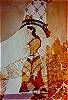 |
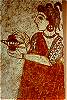 |
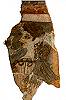 |
 |
||
| Santorini | Santorini | Crete | Crete | Tiryns | Tiryns |
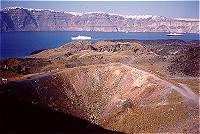 In 1450 BC, all palaces on
Crete were destroyed (evidence of great fires remains). For a long time, archeologists
thought that the explosion of the volcano on Santorini (left) accounted for the sudden and
utter destruction of Minoan civilization, but this theory has recently been disproven.
Stratigraphy studies have shown an era of Minoan settlements after ancient Thera's ash
rained upon the island of Crete. Perhaps invading Myceneans were responsible...
In 1450 BC, all palaces on
Crete were destroyed (evidence of great fires remains). For a long time, archeologists
thought that the explosion of the volcano on Santorini (left) accounted for the sudden and
utter destruction of Minoan civilization, but this theory has recently been disproven.
Stratigraphy studies have shown an era of Minoan settlements after ancient Thera's ash
rained upon the island of Crete. Perhaps invading Myceneans were responsible...