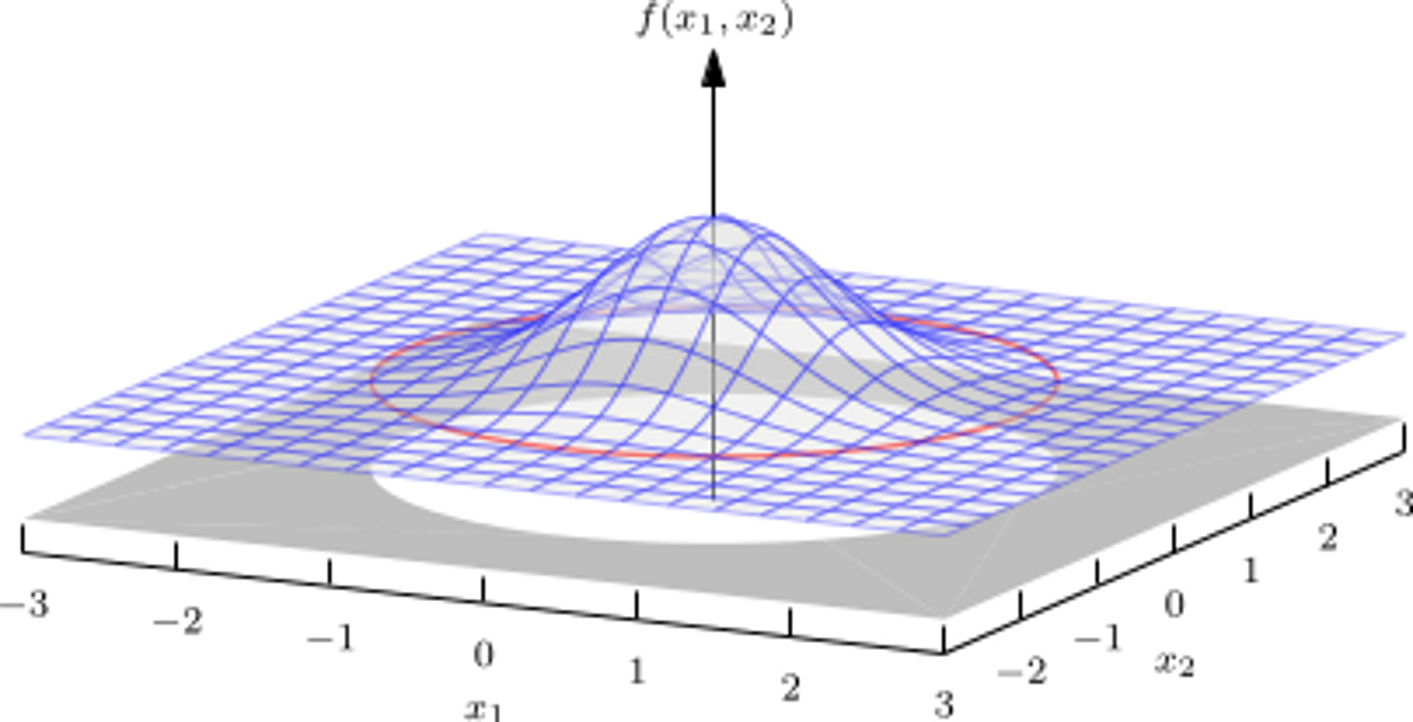
Today we talked about covariance and multivariate normal
distributions. We started with the following warm-up problems:
Suppose that
are i.i.d.
random variables. What is the joint density function for the random
vector
?
Let
.
Notice that
is rotation matrix for an angle of
.
Let
where
has the joint distribution above. What is the joint distribution
function for
?
Definition (Covariance)
Suppose
and
are random variables with respective means
and
.
The covariance of
and
is
Show that the following alternative formula for covariance is also
valid:
Theorem (Covariance is Linear)
Suppose
and
are random variables and
are constants. Then,
Theorem (Covariance is Symmetric)
Suppose
and
are random variables, then
Theorem (Covariance of Independent Random Variables)
Suppose
and
are independent random variables, then
.
Notice, this is not an if and only if theorem. The converse is not
always true.
You can also talk about the covariance of random vectors.
Definition (Covariance Matrix)
Suppose that
is a random vector with entry-wise means
.
The covariance matrix for
is
Observe that the entry in row
,
column
of the covariance matrix is the covariance of
and
:
It is not hard to show that covariance matrices have the following
linearity property:
Theorem (Linearity of Covariance Matrices)
Suppose that
is a random vector and
is a matrix of the right size so that
makes sense. Then
Definition (Multivariate Normal Distribution)
A random vector
has a multivariate normal distribution if the joint
density function for
is
where
is the vector of entry-wise means for
and
is the covariance matrix of
(and
is the determinant of
).
The parameters for a multivariate normal distribution are the vector
and the covariance matrix
.
These completely determine the joint distribution function.
If
is the
-by-
identity matrix and
,
then
has the standard multivariate normal distribution:
What is the covariance matrix
for the random vector
in exercise 1?
Wednesday, February 26
Today we will look at some applications of Multivariate Normal
Distributions (MVNs). Recall that a MVN distribution can be completely
described by two pieces of information: the vector of means
and the covariance matrix
.
Theorem (Transformations of Multivariate Normal Distributions)
If a random vector
has a multivariate normal distribution with vector of means
and covariance matrix
,
and
is any matrix, then the random variable
has a multivariate normal distribution with mean
and covariance matrix
.
Remark: We didn’t prove this theorem, but the proof
when
is invertible is one of this week’s homework problems. The theorem is
still true, even if
is not invertible, but that is a little harder to prove.
Suppose that
and
.
Find the distribution of
where
and
.
(Hint:
is a linear transformation of
.
What is the transformation matrix?) What is the the joint density
function for
and
,
and how can you tell that
and
are independent random variables?
Theorem (Independence and MVNs)
If
are i.i.d. normal random variables with mean
and variance
,
and
,
then
and
are independent random variables if and only if
and
are orthogonal.
Suppose
are i.i.d. RVs. What is the covariance matrix for the random vector
?
Suppose that
are i.i.d. RVs. Show that the average value
is independent of
for every
.
An immediate consequence is the following result.
Theorem (Independence of Sample Mean and Sample Variance)
If
is a random sample of
independent observations chosen from a population with a normal
distribution, then the sample mean
and the sample variance
are independent random variables.
Use what you know of MVNs to say what the distribution of
is. Do you get the same answer as what you get using MGFs?
Friday, February 28
Today we defined the
-distribution
and we used it to explain why you divide by
instead of
in the formula for the sample variance.
Definition
(-Distribution)
Suppose that
is a random vector whose entries
are independent
random variables. The
-distribution
with
degrees of freedom is the probability distribution for $|X |^2.
Let
be independent
random variables. Let
.
Use a polar coordinates change of variables to set up and calculate a
double integral for the probability
for some fixed
.
Theorem (Orthogonal Projection &
)
Suppose that
is a random vector whose entries
are independent
random variables and
is an orthogonal projection matrix. Then
has a
distribution with degrees of freedom equal to the dimension of
.
We didn’t try to prove this theorem, but if we have time later in the
semester we might come back to it. As an application of this theorem,
consider the sample variance of a collection of independent observations
from a normal distribution with mean
and variance
:
The expression
and we proved in Homework 3, Problem 2 that
is an orthogonal projection.
What is the nullspace of
.
Hint: show that a vector
is in
if and only if all of the entries of
are the same.
Use the Fundamental Theorem of Linear Algebra to show that the
dimension of
.
From this, we can see that
is
multiplied by a random variable with a
distribution.
Theorem (Distribution of Sample Variance)
Suppose that
is the sample variance of
independent observations from a normal distribution with mean
and standard deviation
.
Then
has a
-distribution
with
degrees of freedom.