|
|
|
LAB 12: HEART FUNCTION
Introduction
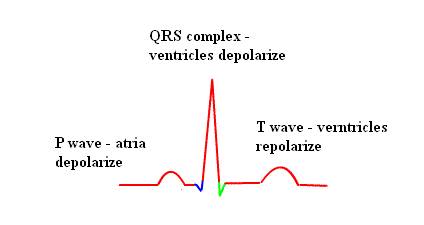
I don’t have this lab completely worked up as yet, so this is a first draft of the kinds of things we will be doing in lab today, I will get an updated handout to the class before the lab meets. You are familiar with the Power lab system. Today we are going to study the pattern of electrical activity of muscles in the human body. We will setup and run a ECG which measures heart rate based on the electrical impulses passing across the heart. An ECG trace has three peaks:
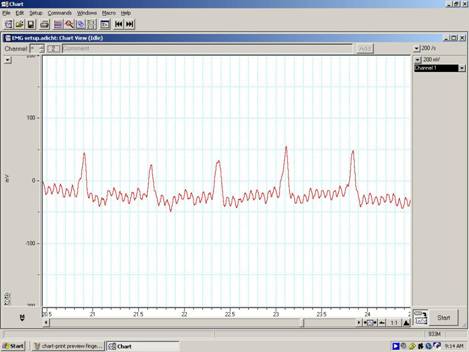
To calculate the heart rate, you usually count the number of QRS complexes as they are the bigger and easier to see. But you could also calculate the atrial rate by counting the P waves. In the trace below, what is the subject’s ventricular rate in beats/minute? What is the atrial rate?
Pre-Lab Questions
1. What is an ECG?
2. Why are there electrical impulses in muscle tissue?
3. Will we use the stimulator function of the PowerLab system in today’s lab? Why or Why not?
Procedures
A. Setup and run an ECG.
B. There are a number of things we can do in this lab, here are some interesting ideas of the kinds of things we can do. When an animal dives underwater for a sustained period of time, it commonly changes its physiology. Because the lungs are not receiving any fresh air, the blood is not carrying much Oxygen. Therefore, the animal shifts to anaerobic respiration and reduces its blood flow to the muscles. This means it can save energy by reducing heart rate.
A harbor seal at the surface of the water has a heart rate of 120-140 bpm. When it dives, however, its heart rate may decrease to fewer than 20 bpm. Humans also have this reflex, and it has been used clinically to reduce the heart rates of clients in the emergency room. The reflex is usually elicited by having the client submerge his or her face in a basin of ice water.
In babies, it is sometimes elicited by putting a latex glove filled with ice water on the child’s face. Your task in this lab is to evaluate whether placing a washcloth soaked in ice water on a subject’s face will elicit the diving reflex strongly enough to significantly reduce her heart rate.
1. Design a class experiment - you will have to explain your method in enough detail so that everybody does the same thing and results are comparable
2. Design a class data sheet, and create it on Excel so everyone can enter their data
3. Use the PowerLab system to gather data on heart rate with and without a cold washcloth
4. When you analyze the data: Calculate the average heart rates before and after ice-water washcloth. Do this by adding all the scores and dividing by the number of scores.
Materials:
PowerLab Hardware and software Electrodes for running ECG’s and measuring Gel to facilitate electrical coupling of electrodes to skin Ice water and washcloths |